Inside The Life Of A Professional Player – Ford Football Ferns Claudia Bunge, Manaia Elliott and Kate Taylor interviewed
Last month, to mark New Zealand Football’s Girls’ and Women’s Month 2025, Ford Football Ferns Claudia Bunge, Manaia Elliott and Kate Taylor spoke to Ferns legend Annalie Longo about forging a career in the game.
A selection of the answers from their interview, watched by up and coming female footballers, can be read below.
Annalie Longo:
Welcome everyone. We've got three of our very awesome Ford Football Ferns, Kate Taylor, Claudia Bunge and Manaia Elliott with us.
Claudia is currently playing for Melbourne Victory. She's a defender with 33 caps, and she's played in the A-League and overseas in Denmark.
Kate Taylor is currently playing over in Dijon in France. She has 23 caps with the Ford Football Ferns and including an awesome goal I'm sure lots of you saw at the Paris 2024 Olympic Games.
And Manaia Elliott is currently playing at the Wellington Phoenix. She's an attacker who made her Ferns debut in Costa Rica in the last international break. So our new one of our newest Ford Football Ferns to join.
All right, so I'm going to ask you all the same question, what inspired you to pursue football as a career, and how did you get into football?
Claudia Bunge:
I remember watching, it was either the U17s or U20s World Cup that was hosted in New Zealand, and I actually think Flea (Annalie Longo) was on that team, and I was at North Harbour Stadium, and I watched the girls play, and I just thought it was the coolest thing ever.
I came through the ranks, playing with boys, as most people had to, because there weren’t a lot of girls teams in West Auckland. I started out and then moved to Glenfield Rovers, and then played U17s, U20s, and now playing in the Ferns.
Kate Taylor:
Yeah, I guess mine’s probably kind of similar to Claud’s. Playing other sports really helped me early on. There weren’t many pathways in the other sports that I played, so it was kind of a natural lead into football.
I just played as much as I could, whatever that looked like. That started in Christchurch playing with boys as well. Then moving into the Pride system, National Women’s League, the Phoenix, and now I’m overseas.
Manaia Elliott:
Very similar to both Claudia and Kate. I grew up playing boys football. I started because my brother played and I probably just wanted to be like him.
My family moved to Hamilton, so I played there, then moved to the Wellington Phoenix Academy, and from the academy, got into the first team.
Annalie Longo:
Did you all play school football and club football growing up?
Claudia Bunge:
Yeah, I did. The girls games for 1st XI were always midweek, so you could play 1st XI during the week and then club on the weekend. It was a lot of football. I absolutely loved it.
Kate Taylor:
Yeah, me too. It was awesome. A bit more of a social kind so no pressure, just hang out with your mates.
Manaia Elliott:
Yeah, very similar. Played school football and was lucky enough to attend St Peter’s in Cambridge. Definitely hard to balance school and club, very busy schedule, but I loved playing with all my friends.
Annalie Longo:
Do you think going back, you would stay in mixed football environments or would you prefer a girls only environment?
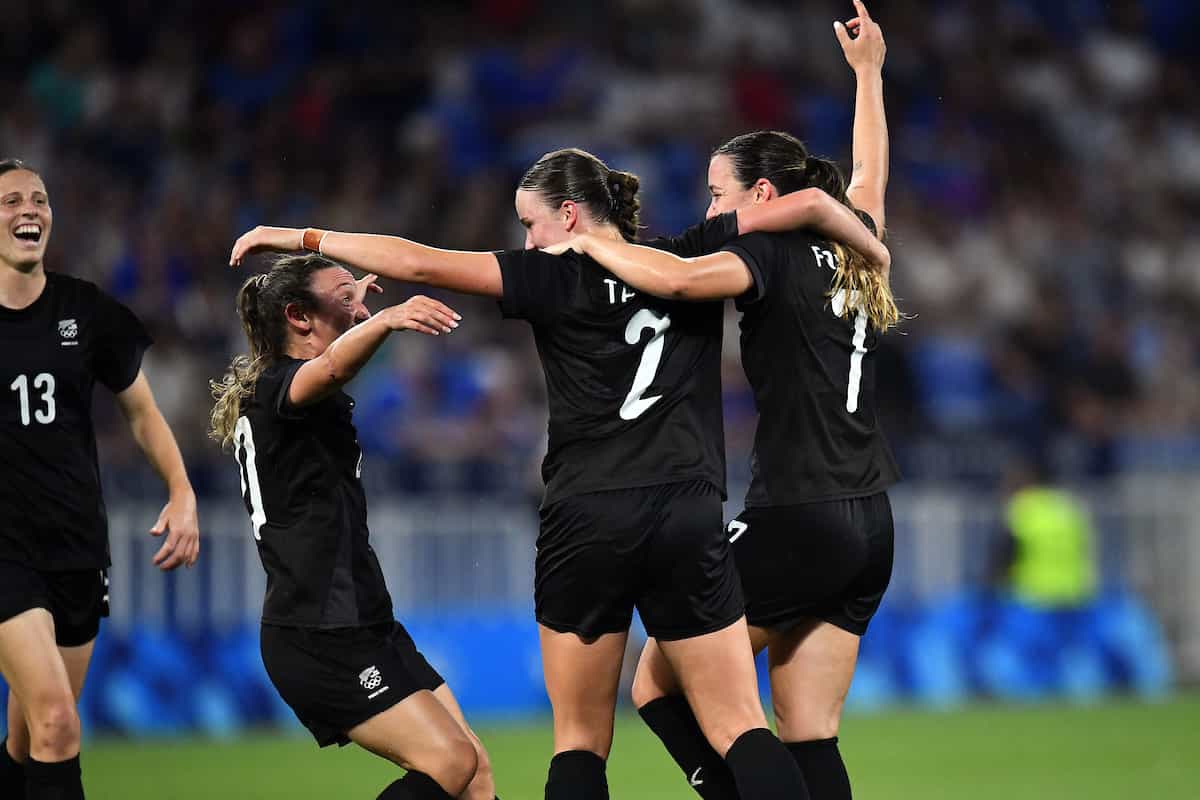
Kate Taylor celebrates goal at Paris 2024 Summer Olympics (Photosport)
Kate Taylor:
I started in boys, then I went into girls, and kind of chopped and changed. That was really good for me because I could differentiate what I needed. I had a bit more of the social playing side in the women’s game, and then with the boys, it was about getting some of my technical habits better.
It was definitely hard being in the boys team when I was 17 and the boys were 15, but it was good for leadership. I kind of looked at it differently on and off the field. I’m glad I did that, even though it was really hard.
Claudia Bunge:
I agree with what Kate said. Playing with boys, there’s pros and cons. There just weren’t many girls leagues compared to now.
When I was at Waitakere, I was in a girls team, U17, but we were playing in a U15 boys league. We actually did quite well.
You’d get a lot of boys teams like, oh what are we doing playing against girls, and then we’d usually go and beat them. That was quite nice. But physically, it gets hard eventually. I think it really helps you individually as a player.
Manaia Elliott:
The boys environment I grew up in was the best option for me. I wouldn’t be here today if I didn’t play boys football.
I grew up in a small place outside of Wanaka, so there weren’t many girls playing football. The boys team was the only option. Later, at Melville United and Cambridge, the boys team felt like my team.
At times it’s hard physically, and sometimes you play down an age group. But it definitely made me the player I am today.
Annalie Longo:
Kate, can you describe your daily training routine and how you prepare mentally and physically for games?
Kate Taylor:
We train in the mornings at around 10:30am. I wake up and try to get my body moving — a walk or stretching.
We do team activation from 10am. You can do your own rehab or technical stuff before that.
Then we’re out on the pitch, usually for an hour and a half. Every day is structured differently depending on how many days until the game. Some days we have gym, some we don’t. I love the gym — it’s helped me a lot over the years.
Mentally, I like to journal and take notes about the opposition and tactics. I can revise for games and look at my personal goals.
I also listen to music, a few Kiwi songs, to remind me of who I am and where I come from.
Annalie Longo:
Claudia, how do you deal with criticism or pressure — from fans, media, teammates?
Claudia Bunge:
Something I’ve learnt is honestly just to not read it. If someone’s giving you hate, you don’t know them — their opinions don’t really matter. The only people whose opinions matter are your family and teammates.
They don’t see what you go through every day in training. A lot of hard work goes in, and I think people don’t realise that. That’s why not everyone does what we do.
Annalie Longo:
Is there anything you do on the pitch when there’s a big crowd or noise?
Claudia Bunge:
The Eden Park one was cool — everyone cheering for us. I just try to take a moment to appreciate it.
When there are noises for the opposition, I find that motivating. I actually really like away games. If you’re getting heckled, just laugh it off and focus on the game.
Annalie Longo:
Kate, do you have any pre-game rituals or superstitions?
Kate Taylor:
I like to brush my teeth before we go out, which is a little bit weird, but it helps me feel fresh.
I also started putting my pounamu where my shirt was, so it’s like I’m borrowing the shirt for 90 minutes. It sits in the changing room with my stuff, and then I get to take it back after the game.
Annalie Longo:
What can an aspiring player do to get noticed?
Kate Taylor:
Playing in anything possible. Signing up for things — like Fantails days. Asking questions helped me, but also just getting stuck in and working hard.
Manaia Elliott:
Take every opportunity to play. Even if it’s out of your comfort zone, still attend and try to make the most of every situation.
People will see you eventually. It might not happen straight away, but the more opportunities you take, the more likely you are to get noticed.
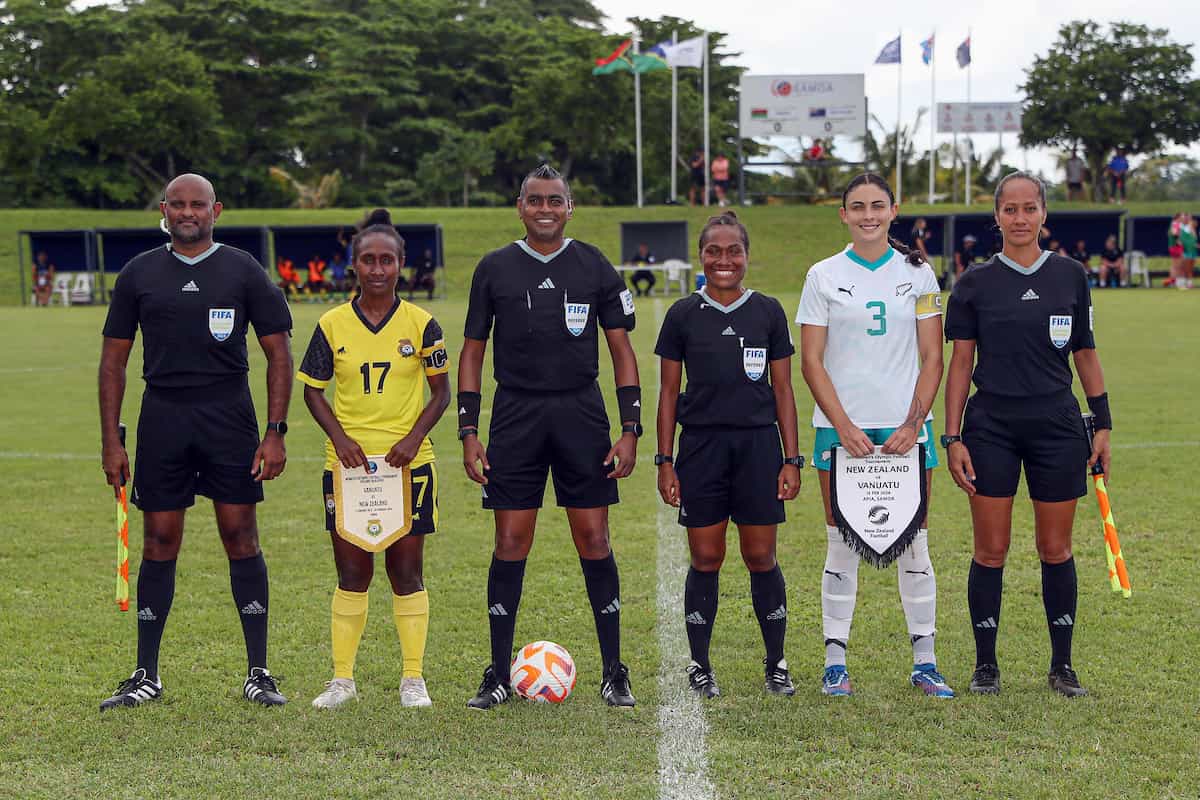
Claudia Bunge captaining the Ferns in the OFC Women's Olympic Qualifying (Photosport)
Annalie Longo:
Claudia, what makes a great team player in your opinion?
Claudia Bunge:
How willing you are to learn. Football’s a simple sport but has so many components. Players who want to learn and get better will go the furthest. And like the girls said — take opportunities and work hard.
Annalie Longo:
Kate, how do you build chemistry with new teammates, especially when joining a team that speaks a different language?
Kate Taylor:
You have to be yourself, but also bring a little something extra.
We started hanging out off the field — activities and challenges — and then training every day helps. Even when you don’t speak the same language, you can connect through football. The connections don’t always have to be verbal.
Annalie Longo:
And your coach — does he coach in English?
Kate Taylor:
During the week, he swaps between English and French. But on game day... it’s French. I end up just asking teammates — they’re willing to help.
Sometimes I miss the nitty gritty things, like if it’s a one-touch game or something, and then you lose a point for your team.
On the field, I have to be very specific with what I ask, and say it very slowly.
Annalie Longo:
So in terms of studying an opposition, Claudia, how do you prepare for a match?
Claudia Bunge:
Yeah, so we do quite a bit of analysis at Victory. We have our team meetings where we go over the opposition, and the coaches are really good. They’ll always provide us with extra footage if we need it. For me, I’m a centre-back, so I often look at the direct striker or winger I’ll be playing against, just to understand some of their characteristics.
That’s really great. I’ll look at that footage throughout the week, but then the day before the game, I like to not really think about football. That’s quite important for me — just to be as relaxed as possible. So if we’ve got a Saturday game, Friday and Saturday I try to stay pretty chill.
With the Ferns, it’s similar. We get given footage of past games the teams have played, and we can get individual clips of the players we’ll come up against. If we have any questions, the coaches are really willing to pull up training footage too, which is great. Drones are a thing now, so it’s really easy to get access to that footage — back in the day, you couldn’t do that. So it’s really good with the technology now; we can see anyone in any game pretty much anytime.
Annalie Longo:
And Manaia, do you adjust your style of play depending on the opponent?
Manaia Elliott:
Yeah, definitely. First of all, it depends on what formation and players you come up against. As a winger, I find playing against a left-footed player versus a right-footed player can be quite different.
I like to remember that what I do doesn’t depend on the player I’m playing against — I can control what I do — but it is insightful to look at the tendencies of the person you’re up against and know where their weaknesses are.
Annalie Longo:
Kate, what’s been your most challenging opponent or team to face, and why?
Kate Taylor:
I’d say as a complete team, Lyon. They just have so many different players, and they balance each other so well. They’re very similar in some ways but very different in others. Honestly feels like there’s 15 of them on the field versus your 11.
On the other end of the spectrum, Costa Rica were very sporadic — you’re not sure what’s coming next. That’s also really challenging. You just have to know what you’re trying to get out of the game and trust your game plan.
Annalie Longo:
You've all had individual performance plans in the past. Any advice for someone in an environment with limited access to team training?
Claudia Bunge:
Yeah, it’s really difficult if you don’t have a lot of resources. But I’d always try to get a friend, or in my case — and maybe Kate and Manaia’s too — my brothers helped me a lot when I needed drills. If you’ve got a coach you can go to for pointers, that really helps as well.
Manaia Elliott:
I did a lot of futsal growing up — helped a lot with ball mastery and control. In terms of drills, just anything to get touches on the ball. Juggling was a big one.
Also, I looked into sprint training in the off-season and worked with some awesome sprint coaches. Football is very specific, but there are lots of components to it. People are so willing to share their knowledge, so go out there and learn — it can help grow your game so much.
Kate Taylor:
When I was a kid, I just loved getting out there and tinkering with different ideas. Kicking a ball against a wall — it comes back at you, and you have to deal with whatever it gives you. I think that was really helpful.
Annalie Longo:
Injuries are part of football, unfortunately. How do you cope with the mental and physical aspects of injury?
Manaia Elliott:
Injuries are so tough and often inevitable. The most important thing is knowing an injury doesn’t define who you are. I’ve been lucky not to have too many injuries so far, but when it happens, use it as an opportunity to grow other things. Count the small wins in your recovery, and when you return, take the pressure off. You're not always going to pick up where you left. Be kind to yourself.
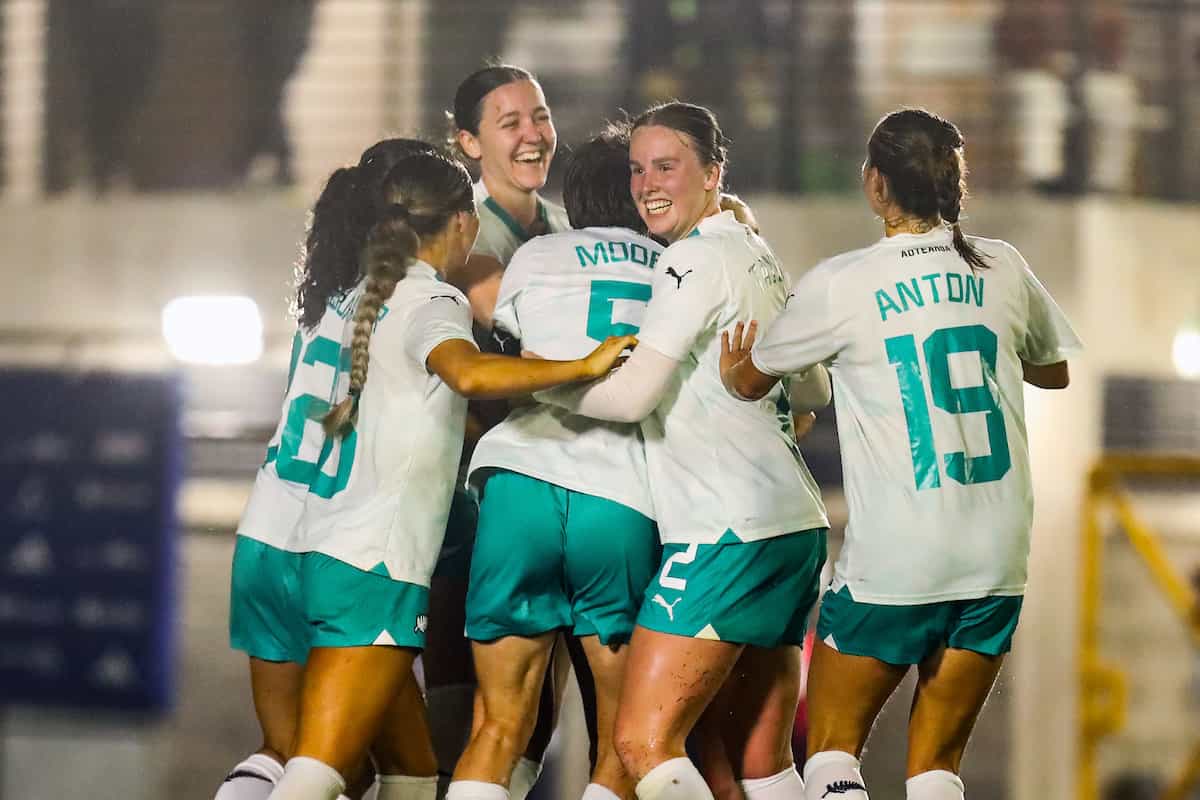
Ford Football Ferns celebrating win over Costa Rica in February 2025 (Photosport)
Annalie Longo:
How important is nutrition to you in your overall performance? Claudia, take us through your game day nutrition.
Claudia Bunge:
I feel like I’ve finally got my game day nutrition down. I’ve dabbled in a few different things to figure out what works, and everyone’s different. In Australia, it’s often really hot, so eating and hydrating is even more important.
I usually have eggs on toast with a coffee. I’ll have two or three coffees a day — need my caffeine to feel like a human. Then some muesli, yoghurt, lots of fruit. Before the game, I’ll have a bit of pasta, nothing fancy, but high in carbs. And I drink heaps of water — we can lose two to three litres per game!
Eating well through the week is just as important. I think as women, we don’t eat enough, but as athletes we need more. It helps with everything — sprints, tackles, avoiding cramps. I try to have my last meal two and a half hours before kick-off. If I’m hungry closer to the game, a muesli bar or a couple of lollies help. At halftime, I’ll have a banana or muesli bar too — you lose a lot of energy in 45 minutes.
Annalie Longo:
Let’s talk about life balance. How do you manage your personal life with the demands of football?
Kate Taylor:
Since moving overseas, I’ve put more emphasis on it. Mornings and evenings are when I call my family back home. Football takes up the middle of the day, and in the afternoon I do things I enjoy — reading, walking, just chilling. I think it’s important to reflect on your day and try again if the balance isn’t quite right.
Manaia Elliott:
I think it’s just as important to have things outside football that give you energy for football. I do university, which keeps me busy. When I’m not studying, it can be hard not to get totally consumed by football, so having good friends, family, and hobbies outside of the game really helps.
Annalie Longo:
And have you started thinking about life after football?
Kate Taylor:
I think I have, indirectly. Growing up, I always wanted to be a midwife or a nurse — there are definitely some similarities with football, which I think is quite cool. I’ve started studying for that. There’ll always be a day when you stop playing, so having another career path is something I’m excited about.
Annalie Longo:
What advice would you give to younger players hoping to make it professionally?
Manaia Elliott:
As long as you’re working hard, you can trust the process. That’s all you can give.
Claudia Bunge:
Similar to Manaia — professional football is hard, so it’s really important to love what you do. Don’t get too fixated on the end product. Enjoy the process and focus on the journey.
Kate Taylor:
I’d say play as many sports for as long as possible. There’s so much crossover between them, and I think it’s really helpful not to specialise too early.
Annalie Longo:
What legacy do you hope to leave in the football world?
Manaia Elliott:
I want to show younger girls that being a professional footballer is a career path. Hopefully by the time they’re ready, we’ve created higher standards and more rights for female footballers.
Claudia Bunge:
Leaving the shirt I’m borrowing in a better place — whether it’s the national team or a club. Just being a good person. It’s a cool job, and we work with amazing people. I want to be the best person I can be, and hopefully that helps me be the best player too.
Kate Taylor:
Helping younger players — on and off the field. For New Zealand Football, I’d love to help us break into the top ten or win a major tournament. That’d be pretty cool to be part of.
Article added: Wednesday 16 April 2025