Historic matches – New Zealand vs United States, 1987
Written by Michael Burgess and supported by the NZ Football Foundation
“When you reflect on it now, they were amazing opposition.'" – Michele Cox
New Zealand vs United States
December 15, 1987
Taipei Hsien Stadium
Wendy Sharpe will never forget the events of December 15, 1987, at the World Invitational Tournament in Taiwan.
The New Zealand legend had been unsure if she would even be part of the team travelling to Taipei that year, after a devastating family tragedy a few months earlier.
But Sharpe did go, playing a vital role in the unforgettable 1-0 victory over the United States.
“We didn’t really get publicity back then and I don’t think people understand what a huge achievement it was, in a non-professional era,” says Sharpe. “We took them by surprise. We were fit, we were physical, and we took our chances.”
In the history of New Zealand’s women’s football, there haven’t been too many more memorable matches.
On a hot, humid afternoon in Taipei, the Kiwis shocked the USA, lowering their colours for the first and only time in New Zealand’s history.
It was some triumph, as the Americans were a formidable team.
The women’s game had taken off in the States in the late 1970s, especially at college level, and by the mid-1980s the fruits of that labour was clear.
“When you reflect on it now, they were amazing opposition,” recalls midfielder Michele Cox. “They became the stalwarts of US soccer; they stayed there for years.”
Their names read like a Who’s who.
Mia Hamm, who went on to play 276 internationals (158 goals), win two World Cups and was twice named world player of the year. Kristine Lilly, whose international career spanned 23 years and five World Cups. Michelle Akers, top scorer at the 1991 World Cup and recognised as FIFA’s female player of the century in 2002.
Other notable names included Carin Jennings, honoured with the Golden Ball as the best player at the 1991 World Cup and April Heinrich, the first female inducted into US Football’s Hall of Fame.
In hindsight, it helped that the Kiwis didn’t know much about their opponents.“We were largely ignorant,” says Michele Cox. “We didn’t have coverage of the other countries then. There was no way to assess the opposition beforehand.”
And New Zealand was a strong outfit.
Many players were drawn from Auckland’s Eden club, so they were used to playing together.
There was an abundance of natural sportswomen, with several double internationals, including Leslie King, Monique Van de Elzen, Sharpe and Cinnamon Chaney.
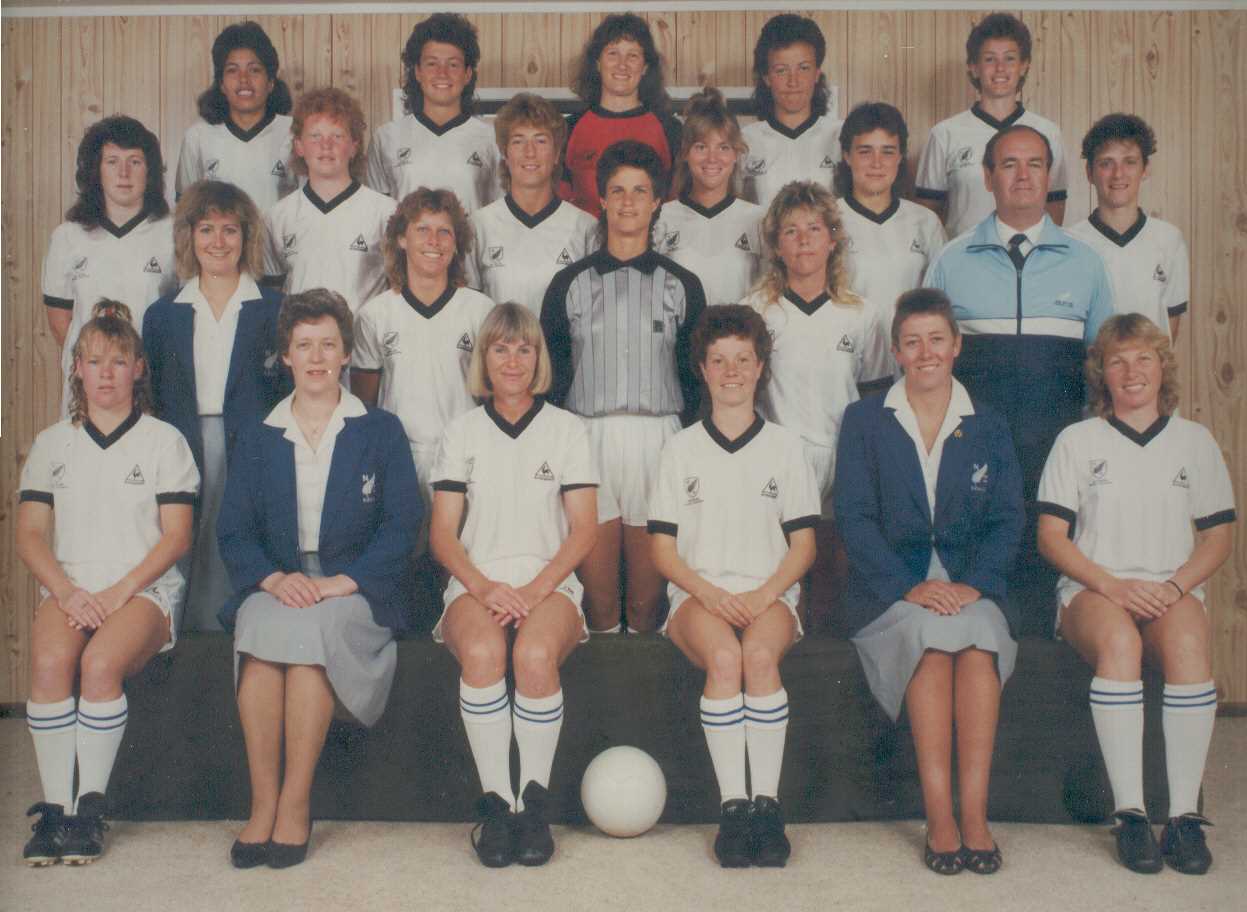
Back row: Tina Salu, Monique Van de Elzen, Rebecca Roche, Julia Campbell, Lyn Pedruco Third row: Donna Baker, Wendi Henderson, Viv Robertson, Michele Cox, Cinnamon Chaney, Audrey Rigby Second row: Nicky Brown (Physio), Wendy Sharpe, Leslie King, Debbie Pullen, Roy Cox (Manager / Selector) Front row: Julie Inglis, Lesley Boomer (NZWFA CEO), Barbara Cox (captain), Jo Fisher, Jenny Bray (Tour Leader), Ali Grant
“It was the closest thing we had to a World Cup.” – Wendy Sharpe
New Zealand had experience of the famed Taiwan tournament. They competed in 1981 (with wins over Holland, Norway and Taiwan) and again in 1984, where victories over Australia and Switzerland were the high points.
“It was a big stage for us back then, because we didn’t get to play lots of internationals,” said Sharpe. “It was the closest thing we had to a World Cup.”
In 1987 New Zealand warmed up with a game against Taiwan, before the USA meeting two days later. With the match scheduled for 2pm, the Kiwis were surprised to see their opponents doing drills more than an hour before kick-off.
“We were saying ‘what are they doing, they are going to wear themselves out’,” laughs Michele Cox. “We didn’t know any better…but maybe we were right.”
New Zealand, coached by John Adshead and Roy Cox, had few expectations ahead of the match.
“You just went out and played,” says Barbara Cox. “You knew you were in for a hard game, and the result will be what it is. It wasn’t ‘oh, it’s the USA, it’s going to be scary’. That attitude stood us in good stead.”
New Zealand started well, with Van de Elzen and Sharpe forcing good saves, while goalkeeper King was in action early, keeping out a couple of American shots.
There was a five strong defence in front of her, with veterans Barbara Cox (40) and Viv Robertson (32) marshalling Julie Inglis (24), Michele Cox (19) and Chaney (18). King had a fabulous game, while the whole team fought tremendously.
“Sometimes it was like a siege, pretty much,” says Michele Cox. “We were under a lot of pressure.”
But it wasn’t completely one way traffic. New Zealand forced five corners in the first half, without a breakthrough, while Alison Grant and Van de Elzen were constant threats on the flanks.
Captain Barbara Cox, a mainstay since 1975, was in her element. She had required seven stitches above her eye after a head clash with teammate Audrey Allen in the Taiwan friendly, but was never going to miss this match.
Her job got incrementally harder in the second half, as Akers was brought on.
“At the time, she was probably the best player in the world,” says Barbara. “She was amazing – tall, fast and strong. I would normally mark strikers from behind but every time the ball came anywhere near her, I dashed in front and jumped as high as I could, to try and put her off getting the ball.”
“There was definitely the look on their faces of ‘Oh, how could this happen?’ I don’t think they were very happy, put it that way.” – Barbara Cox
New Zealand’s magic moment came in the 50th minute, as they sprung a breakaway attack.“A ball came to me in defence and I just hit it,” says Barbara. “The ball penetrated through their left back and the sweeper.”
Midfielder Julie Campbell produced a pinpoint cross from the right, which Grant headed past the onrushing American keeper.“
Ali was dynamite,” recalls Michele. “She scored and from there we kept them out. They were quite desperate – I think their coach had underestimated us.”
Sharpe adds: “When we scored, we celebrated like we had won the World Cup. [But] we still tried to get a second goal.”
The Americans upped the tempo – with a lot of one touch football – but the Kiwis were playing above themselves. Teenager Chaney locked up the left defensive channel, while Michele Cox, normally a midfielder at club level, was stoic on the right, in just her third international and had also put a chance just wide in the first half.
The Kiwis hung on, to record a famous victory.
“I remember them coming off the field and gathering around their coach,” says Barbara Cox. “There was definitely the look on their faces of ‘Oh, how could this happen?’ I don’t think they were very happy, put it that way.”
Sharpe, later honoured as one of the players of the tournament, still recalls the jubilation.
“We were relieved that the game was over,” says Sharpe. “The feeling of ‘Yes, we have actually done it’”.
According to Michele Cox, the loss was pivotal for the United States.
“They launched into a big review [after that tournament] and that is what changed US Soccer,” says Cox. “They became the best players and best coaches of the USA.”
Despite a punishing schedule, with five games in six days, New Zealand also toppled Australia (1-0) and Canada (1-0) and were shaded by West Germany (0-1) to finish second equal in the last World Invitational tournament.
“Those events helped change FIFA’s opinion of women’s football,” says Barbara Cox.
Michele agrees: “It was brilliant. Live TV coverage, massive banquets, it was way before its time. It was the driver, the precursor to the Women’s World Cup.”
“I had never experienced a traumatic event like that. It was a tough time but there was light at the end of the tunnel” – Wendy Sharpe
Sharpe made her debut as a 16-year-old in 1980 and retired in 1995.
Only Amber Hearn (54) has more international goals than her 34.
She played in all three Taiwan tournaments (1981, 1984 and 1987), which were career highlights, with crowds of 35,000 when they faced the host nation and lavish opening ceremonies.
They were treated like football royalty – “if you finished in the top four every player got a trophy” – and often rose to the occasion.
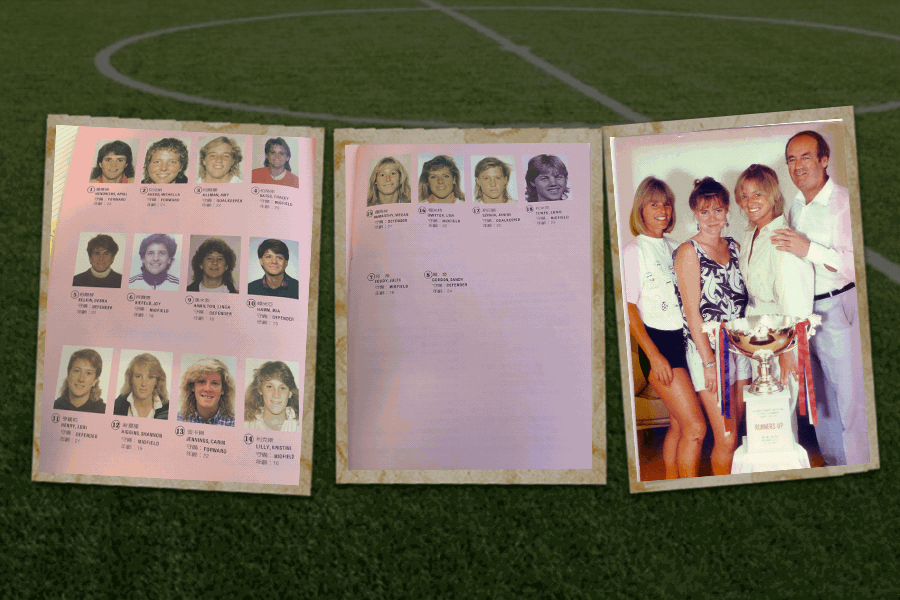
Left and middle images: Members of the US Women's National team defeated by New Zealand
Right image from left: Barbara Cox, Tara Cox (who would later play for the Football Ferns and was in Taiwan as spectator), Michele Cox, and Roy Cox (manager/selector) pose with the trophy awarded to New Zealand for coming joint second
There were other perks, with a favourable exchange rate, and a huge manufacturing base making Taipei a shopping Disneyland.
“We were always looking forward for our day off to go shopping, because things were so cheap,” recalls Sharpe. “The coaches would always say it’s a rest day, you shouldn’t be walking around. But we often needed extra suitcases.”
But Sharpe nearly didn’t make the 1987 tour, after the tragic death of her older sister Trudi in a car accident earlier that year.
“I had never experienced a traumatic event like that,” says Sharpe. “[Manager] Roy Cox put faith in me and gave me as much time as I needed to grieve; there was never any pressure. It was a tough time but there was light at the end of the tunnel, that was my goal after dealing with my sister’s loss.”
Sharpe trained with her club on Mondays and Wednesdays, then with Auckland on Fridays, interspersed with road runs on Tuesday or Thursday, to maintain stamina.
In 1987 she worked full time for a pharmaceutical company, though was fortunate to have North Harbour rugby coach and future All Black selector Peter Thorburn as her boss.
“With his background, being a sportsman himself, he let me go on full pay,” says Sharpe. “It was the only job I got full pay; all the other times you had to use your holiday when you went away to play. There were a lot of personal sacrifices but you wouldn’t do it if you didn’t love it.”
“As a 15-year-old, I said to Mum and Dad I want to play for New Zealand and travel the world. I was blessed; I did it for 16 years.”
Her passion has never dimmed – “If they told me there was a Masters tour, I’d go back over again” – because of the love of the game and the wonderful recollections.
Sharpe and her teammates will always remember that special day in Taipei, when New Zealand beat the nation that would go on to dominate the female game.
“We realised they were good but they were also just another country,” says Michele Cox. “Now it is a special memory, because we know how good they are.”
“It’s a pretty big honour when you look at who they become, but maybe we contributed to that; they didn’t like that this little football nation beat them.”
Sharpe concurs: “We had a strong core of players that had been together a long time. We knew it was going to be a really hard game but we put our heads down and battled away.”
New Zealand 1 (Alison Grant 50’)
United States 0
Halftime: 0-0
New Zealand: Leslie King, Alison Grant, Julie Inglis, Barbara Cox, Cinnamon Chaney, Vivienne Robertson, Julia Campbell, Monique Van de Elzen, Wendy Sharpe, Donna Baker (Debbie Pullen), Michele Cox
Other touring squad members:Rebecca Roche, Lyn Pedruco, Audrey Allen, Wendi Henderson, Johanna Fisher, Tina Salu
Article added: Thursday 23 September 2021